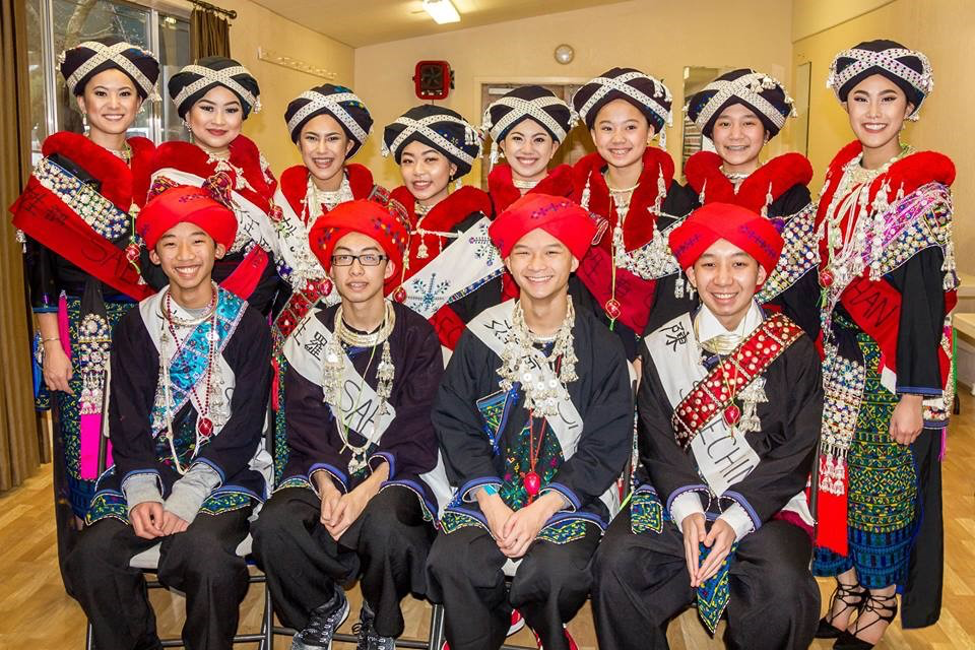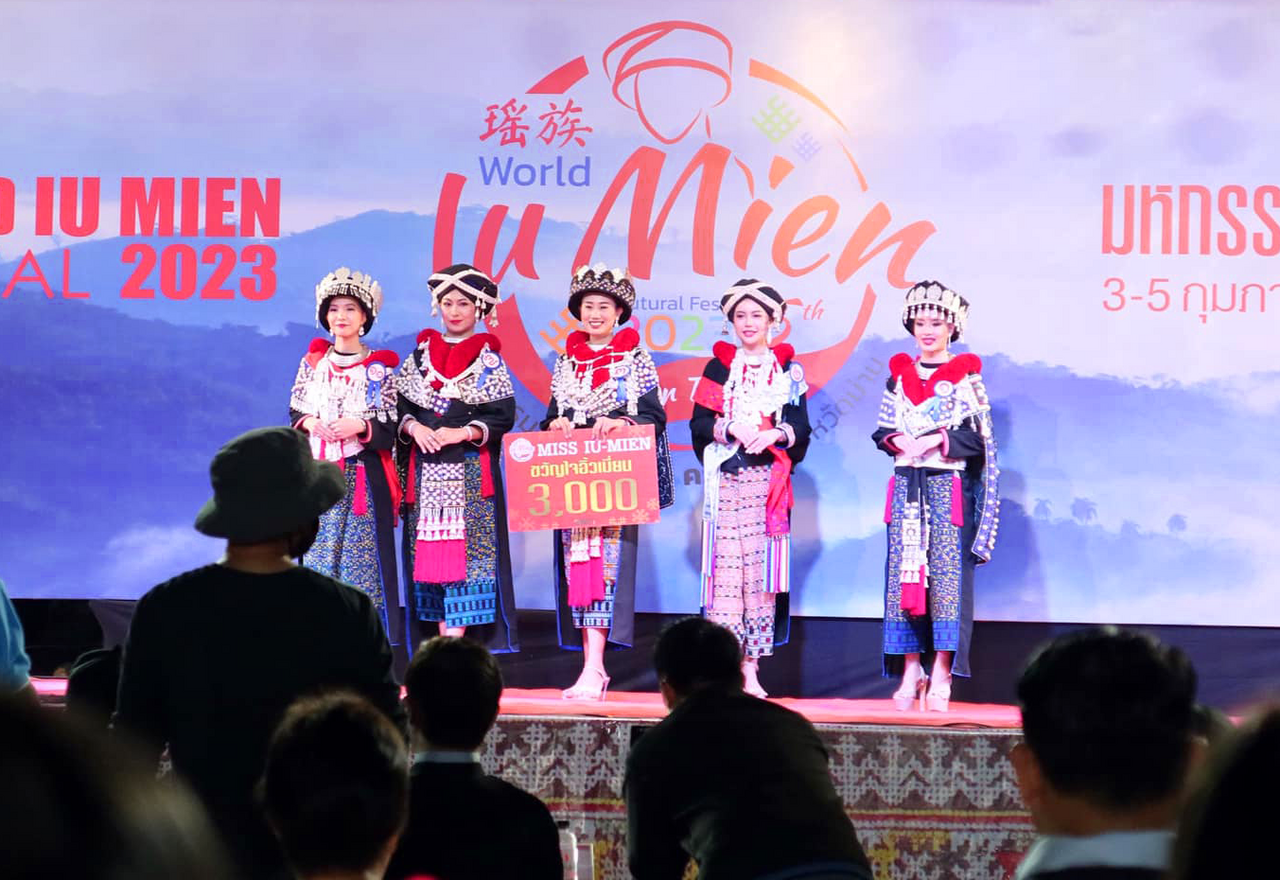
A Hmong-Mien language with ~800,000 first-language speakers (Ethnologue 2019), nested inside a broader Yao ethnic community of ~2.6 million spread across China, Vietnam, Laos, Thailand, and the post-1975 diaspora. Three centuries of continuous highland migration.
Iu Mien lineage traces to the Yangtze River basin. Religious texts begin with King Pan, founder of Mien Daoism.
Initial groups cross from Yunnan into the Lao highlands, seeking arable mountain slopes.
Severe drought in southern Yunnan triggers secondary migration into Laos and Thailand.
Many Iu Mien serve as US allied forces in Laos. After 1975, mass exile begins.
Over 40,000 resettle in the US. Sacramento County alone hosts more than 14,000 today.
Younger US born Mien rarely speak fluently. Active preservation by communities and digital tools.
Other people doing this work. Community orgs, dictionaries, references.
Sacramento, est. 1994. Health, language classes, family programs.
Cultural events, youth programming, heritage preservation.
Oakland, est. 1982. King Pan Temple and community center.
Free PDFs: alphabet books, grammar references, audio Bible.
Iu Mien (also written Mien, Mienh, Iu-Mien, Iuh Mienh, Yiu Mienh, or Lu Mien) is a low resource language in the Mienic branch of the Hmong-Mien (Miao-Yao) family. Roughly 200,000 speakers live across Laos, Thailand, Vietnam, southern China, and diaspora communities in the United States, France, and Canada.
Yes. "Lu Mien" is a common alternate romanization of "Iu Mien" used in many diaspora communities, particularly Mienh families resettled in California, Oregon, and Washington. The two spellings refer to the same language and ethnic group. The unified 1984 orthography prefers Iu Mien, but Lu Mien is widely understood and accepted.
Partly. "Yao" (瑶) is an exonym used loosely. In China it is an official ethnic classification covering several related Mienic subgroups including Iu Mien, Kim Mun, Biao-Jiao Mien, and Yao Min. The Iu Mien are one of those subgroups. There is also a completely unrelated Yao group in Malawi, Mozambique, and Tanzania (a Bantu language). The Iu Mien refer to themselves as Mien or Mienh.
Most modern Iu Mien is written in the Unified Mien Romanization (IuMiNR), adopted in 1984: a Latin alphabet using tone letters such as -c, -h, -v, -x, -z at word ends. Han characters and Thai script are also used, especially in older texts and for ritual or literary varieties.
China (Yunnan, Guangxi, Hunan) has the largest population. Significant communities live in Vietnam, Thailand, and Laos. After 1977, refugees resettled in the United States (largely California, Oregon, Washington), France, and Canada.
Hmong and Mien are the two major branches of the Hmong-Mien (Miao-Yao) language family. They are related but mutually unintelligible: speakers cannot understand each other without learning the other language.
Learn Iu Mien at https://learniumien.org offers a leveled curriculum, a searchable Iu Mien ↔ English dictionary, and a free neural translator. Account-gated lessons track XP, streak, and progress. The translator and dictionary are open to everyone without an account. The course covers greetings, family, food, daily life, grammar, culture, and ritual language across twenty levels.
"Lu Mien" and "Iu Mien" are spelling variants of the same language. The course at https://learniumien.org teaches the modern unified Iu Mien orthography (1984), which Lu Mien diaspora speakers in California, Oregon, and Washington use as well. Lessons, dictionary, and translator are all free.
Yes. The dictionary at https://learniumien.org/dictionary covers thousands of Iu Mien (Lu Mien) words paired with English. Sources include community contributions and scholarly works (Lombard & Purnell 1968, Purnell 2007). Search works in both directions with trigram fuzzy matching.
Yes. The free neural machine translator at https://learniumien.org/translator translates English ↔ Iu Mien (Lu Mien). It runs a fine-tuned NLLB-1.3B model (v7) and currently scores chrF 62 on a held-out test set for ium → eng.
Yes. The Iu Mien translator at learniumien.org/translator is free to use, with no account and no sign-up required.
Sign in and submit dictionary entries from the Dictionary page, send us recordings or scanned materials, or contact the team at [email protected] for partnership inquiries.